


Lipid Panel Blood Test: Monitoring And Sustaining Healthy

Our platform focuses on helping people stay informed about their cardiovascular wellness through general health insights and educational resources. It was estimated by WHO that 17,9 million people died from cardio-vascular cases in 2016, which accounts for 32% of all global deaths1. Of these deaths, 85% resulted from either a heart attack or a stroke. In more than half of these cases, diseases were clinically silent. Till the very day when heart attacks took away their lives they didn’t feel any pain in their chest, nor any heartbeat disorder, which could point to any heart problems. That is why today we will talk about monitoring and sustaining healthy lipid levels and the importance of doing so for healthy living. A lipid panel can provide general information about cholesterol-related wellness markers.
This article was last reviewed by Svetlana Baloban, Healsens, on January 4, 2022. Last updated: October 15, 2026
The article has been updated to reflect newer cardiovascular prevention guidelines. These updates have not yet undergone a new medical review.
Regular lab checks can help people stay tuned into general heart-health trends so they can support their wellbeing in partnership with their care team. Luckily, for taking the recommended medical tests neither big money nor doctors’ prescriptions or permissions are needed.
A proactive heart-health routine can include discussing various tests and imaging options with your clinician.
The American Heart Association recommends that everyone over age 20 get a lipid panel blood test so you know what your levels are and can do something about them if you need to. The National Cholesterol Education Program (NCEP) recommends that adults have their cholesterol checked every 4-6 years2.
Cholesterol Definition
Cholesterol is the form of fat we need to make outer membranes of our body cells stable. However, doctors have noticed for many years that people with high cholesterol levels suffer from cardiovascular diseases more often.
IN THIS ARTICLE
2
RELATED ARTICLES
In fact, they have discovered recently that different forms of cholesterol (“good” and “bad” cholesterol) also play a role. High levels of total cholesterol, high levels of bad cholesterol or low levels of good cholesterol adversely affect the cardiovascular system. For example, LDL or “bad” cholesterol can stick to blood vessel walls. For many years it can be a major factor in artery obstruction and more specifically in hardening of arteries, the process known as atherosclerosis.
Narrow arteries of your heart can get spontaneous blood clots, causing heart attacks and strokes. And high levels of triglycerides in the blood are associated with higher risks of cardiovascular diseases (CVD), even though the exact reason for this is not clear.
Preventive guidelines for a lipid panel blood test among young adults differ, but experts agree on the need to screen young adults who have other risk factors for coronary heart disease: obesity, smoking, high blood pressure, diabetes, and family history.
Less than half of young adults who have these risk factors don’t get cholesterol screening even though up to a quarter of them have elevated cholesterol3.
Lipid Panel Results
Total Cholesterol Levels
Traditionally, a total cholesterol level below 200 mg/dL (5.2 mmol/L) has been considered desirable. However, research suggests that cardiovascular risk increases progressively with higher cholesterol levels, without a clear threshold. However, some large population studies have used a more stringent threshold of 180 mg/dL (4.65 mmol/L) to define an optimal cardiovascular risk profile4.
The Multiple Risk Factor Intervention Trial (MRFIT), involving more than 356,000 men, found that the risk of death from coronary heart disease increased progressively from 160 mg/dL (4.14 mmol/L) upward. Based on these findings, the researchers proposed a population-level goal of 180 mg/dL (4.65 mmol/L) for average total cholesterol5.
Current cardiovascular prevention guidelines focus primarily on LDL cholesterol (LDL-C) and overall cardiovascular risk rather than a universal target for total cholesterol. Non-HDL cholesterol and apolipoprotein B (ApoB) can provide additional information for risk assessment.
Therefore, total cholesterol should be interpreted alongside the full lipid profile and individual cardiovascular risk factors.
Fact
More than 102 million American Adults (20 years or older) have total cholesterol levels at or above 200 mg/dL, which is above healthy levels. More than 35 million of these people have levels of 240 mg/dL or higher, which puts them at high risk for heart disease.
Low-density lipoprotein cholesterol or LDL Lab Test Results
LDL stands for low–density lipoproteins. It is sometimes called the “bad” cholesterol because a high LDL level leads to a buildup of cholesterol in your arteries. An extra LDL, along with other substances, forms plaque. The plaque builds up in your arteries; this is a condition called atherosclerosis.
To define your own optimum LDL cholesterol you have to consider all risk factors from those listed below:
Serious risk factors:
- Diagnosed coronary heart disease
- Diabetes
- Cardiometabolic syndrome
- Coronary artery calcium (calcium score) lower than 75 percentile for your age. This is an extra recommendation – it is not listed in NCEP.
If you found to have one or more serious risk factors, you are in the group of high risk and it’s time to come to grips with the fact that you have to lower your LDL-C levels.
NCEP recommends the maximum level of LDL cholesterol for this high-risk group is 100 mg/dL (2.58 mmol/L).
Key risk factors:
- Age: older than 45 for men, and older than 55 for women
- Cigarette smoking
- Cases of premature heart disease or cardiovascular disease cases among close relatives (parents, siblings, or children) (older than 55 for men or older than 65 for women)
- High arterial blood pressure (140/90 or higher, or if drugs are taken to normalize blood pressure)
- HDL levels below 40
- Calcium score higher than 25 procentile (this is an extra recommendation – it is not listed in NCEP).
If you have one or less key risk factors, then according to NCEP, your LDL levels must be lower than 160 mg/dL (4.14 mmol/L). At the same time if you have 2 or more risk factors, then you should keep your LDL levels below 130, and below 100 would be even better. People who belong to the high-risk group of getting a heart attack or a stroke recommended keeping LDL levels below 100. Some recent studies show (indicate) positive results when the numbers are kept under 70.
Follow us on Facebook|| Instagram || Telegram || Youtube
High-density lipoprotein cholesterol or HDL Lab Test results
HDL (high-density lipoprotein), or “good” cholesterol, absorbs cholesterol and carries it back to the liver. The liver then flushes it from the body. But the antiatherogenic properties of HDL cholesterol do not end there. Thus, HDL cholesterol has antioxidant properties and shows an anti-inflammatory effect6. In addition, HDL has the ability to increase glucose uptake by skeletal muscle and stimulate insulin secretion by pancreatic beta cells7.
So, high levels of HDL cholesterol can lower your risk for heart disease and stroke. HDL level below 40 mg/dL (or 1.03 mmol/L) is the main risk factor of cardiovascular disease. If HDL level is higher than 60 mg/dL, cholesterol of this type performs barrier function.
At the same time, HDL levels below 40mg /dL among men and below 50 mg/dL among women are the symptom of (indicate, point to) metabolic syndrome, which in its turn, is also a major risk factor for cardiovascular disease.
Note that there are several reasons for low HDL cholesterol. Thus, type 2 diabetes is commonly accompanied by a low level of high-density lipoprotein cholesterol. This contributes to the increased cardiovascular risk associated with this condition. In addition, overweight, obesity, smoking, elevated triglycerides (TG), and physical deficiency are among the main factors of low HDL.
As for physical activity, then a recent meta-analysis has provided some insights into how much exercise is required8. So, an increase in HDL concentration was apparent only in people who exercised for at least 120 minutes each week.
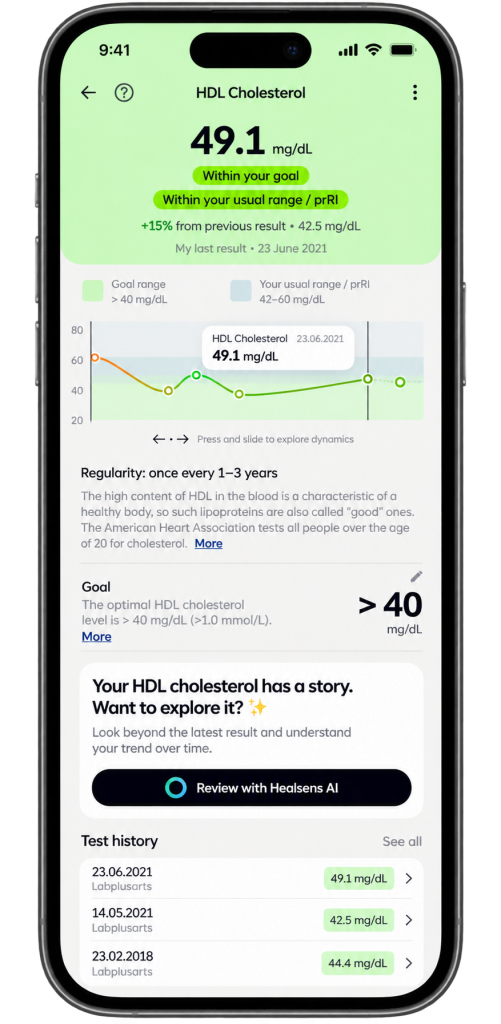
» Discover everything how to increase your HDL Cholesterol
Triglycerides Lab Test results
Triglycerides are the main criteria indicating levels of fat in the blood. The high content of triglycerides combined with low HDL levels is considered a characteristic of metabolic syndrome. Often high levels of triglycerides result from high consumption of sugar-containing products and high glycemic index. The general population’s ideal triglyceride level is less than 150 mg/dL or less than 1.7 mmol/L9 by FDA. Anything over 500 mg/dL is considered very high. At this level, there is a high risk of developing pancreatitis (inflammation of the pancreas). This condition can lead to permanent tissue damage. It is usually accompanied by abdominal pain, which can be very severe.
Guidelines for triglyceride levels in healthy adults are:
- Normal: under 150 mg/dL
- Borderline high: 150-199 mg/dL
- High: 200-499 mg/dL
- Very high: 500 mg/dL or higher
HDL and triglycerides are metabolically connected and are often inversely related: As triglycerides go up, HDL goes down — and vice versa. But that isn’t always so. People can have “isolated” high triglycerides without low HDL levels, and research is now showing that high triglycerides are an independent risk factor for cardiovascular disease, no matter what the HDL is10.
Lipid Panel Blood Test With Additional Additional Classes
Some labs provide advanced cardiovascular and lipid panel blood test that go beyond typical cholesterol testing to uncover risk factors for early heart disease.
As you can see there are two new components are added to this test: Lp(a) and ApoB. Lp(a) (also called Lipoprotein(a) is a lipoprotein subclass. Genetic studies and numerous epidemiologic studies have identified Lp(a) as a risk factor for atherosclerotic diseases such as coronary heart disease and stroke. It is similar to low – density lipoprotein (LDL, the “bad” cholesterol) in that it contains a single apolipoprotein B protein along with cholesterol and other lipids. This test measures the amount of Lp(a) in the blood to help evaluate a person’s risk of developing cardiovascular disease (CVD).
ApoB and ApoA-I are the two major apolipoproteins involved in lipid transport and in the processes causing atherosclerosis and its complications. ApoB is the main protein found in the low-density lipoproteins (LDL). Apo B increases this clogging, so your Apo B level may be a better indicator of cardiovascular risk than even LDL cholesterol.
Lipoprotein(a), or Lp(a)
Lipoprotein(a), also known as Lp(a), is a subclass of lipoproteins.
Numerous prospective studies have convincingly demonstrated an association between elevated Lp(a) levels and cardiovascular disease (CVD). Extensive evidence suggests that high Lp(a) is an independent risk factor for atherosclerosis and thrombosis. According to the American Heart Association, elevated Lp(a) levels increase the risk of acute coronary events by 70%.
Interesting Fact
Lipoprotein(a) was discovered by Kåre Berg in 1963 and is considered a relatively recent evolutionary development.
One of the most important reasons to measure Lp(a) is that its concentration can reveal a genetic predisposition to cardiovascular events, even in people who are currently healthy.
In 2025, the ESC/EAS updated their guidelines for cardiovascular risk assessment, followed by the ACC/AHA in 2026. Both recommend measuring Lp(a) at least once in adulthood 9.
Testing is particularly important for individuals with a personal or family history of premature cardiovascular disease, familial hypercholesterolemia, or elevated Lp(a) levels in close relatives.
Lp(a) reference values:
- <30 mg/dL (<75 nmol/L) – Low Lp(a)-related risk
- 30–49 mg/dL (75–124 nmol/L) – Intermediate risk
- ≥50 mg/dL (≥125 nmol/L) – Increased cardiovascular risk
- ≥180 mg/dL (≈430 nmol/L) – Very high lifetime cardiovascular risk
Using the VAP Test tas Lipid Panel Blood Test
So, VAP test or Vertical Auto Profile provides even more detailed information about lipid levels as opposed to conventional examination, since this lab test directly assesses LDL levels. Traditional tests on the other hand measure only total cholesterol, HDL and triglyceride levels, and then use them to calculate LDL levels using these numbers. However, this is not the only advantage of VAP test, as this test gives additional information about the size and a current number of LDL particles, as well as tells about the number of less dangerous, large and spongy A-particles, and more dangerous small and dense LDL B-particles present in your body. Light and spongy A-particles easily push off the artery walls. On the other hand, small and dense B-particles are destructive and easily penetrate artery walls. An elevated number of small B-particles is often found among patients suffering from diabetes or metabolic syndrome.
Components of Lipid Panel Blood Test
- HDL2 and HDL3 subfractions
- Pattern A or B LDL
- VLDL cholesterol
- Non-HDL
- apoB100-calc
- LDL-R (real)
- Lp (a)
- IDL
- Remnant lipoprotein
Cholesterol VLDL
Very low-density lipoprotein (VLDL) cholesterol is a type of fat in the blood. It is considered one of the “bad” forms of cholesterol, along with LDL cholesterol and triglycerides. This is because high levels of cholesterol can clog arteries and lead to a heart attack.
Normal VLDL cholesterol levels range from 2 to 30 mg/dL (0.1 to 1.7 mmol/L).
The VAP approach provides more detailed cholesterol information that some people review with their clinicians when considering heart-health strategies. In addition, the VAP method is compliant with the National Cholesterol Education Program’s Adult Treatment Panel III guidelines.
If your cholesterol readings are outside your personal goals, consider discussing with your healthcare professional how often to recheck them.
What to do if your lipid profile is outside the healthy range?
Abnormal cholesterol levels don’t always mean you need medication. The best approach depends on your complete lipid profile and your individual cardiovascular risk.
A healthy lifestyle can help improve your cholesterol levels and reduce your risk of cardiovascular disease.
- Quit smoking. Smoking significantly increases the risk of cardiovascular disease.
- Eat a balanced, heart-healthy diet. Choose more unsaturated fats, whole grains, vegetables, fruits, and unsalted nuts. Limit saturated fats and excess salt.
- Stay physically active. Aim for at least 150 minutes of moderate-intensity exercise per week, such as brisk walking or cycling. Include muscle-strengthening activities at least twice a week.
- Reduce prolonged sitting. Take regular breaks to stand up and move throughout the day.
- Pay attention to sleep and stress. Getting enough sleep and managing stress are important parts of maintaining cardiovascular health.
When Is Medication Necessary?
If your cholesterol levels are elevated or your cardiovascular risk is high, your doctor may recommend cholesterol-lowering medication.
Statins are usually the first-line treatment. They lower LDL cholesterol and have been shown to reduce the risk of cardiovascular events, including heart attacks and strokes.
Your LDL cholesterol target depends on your individual cardiovascular risk. People at high or very high risk generally require lower LDL cholesterol levels.
If statins alone are insufficient or are not well tolerated, your doctor may consider additional or alternative treatments, such as ezetimibe, PCSK9 inhibitors, or bempedoic acid.
Can Supplements Help Lower Cholesterol?
Some dietary supplements can affect cholesterol levels, but for most, there is insufficient evidence that they reduce the risk of cardiovascular events.
The 2025 ESC/EAS guidelines do not recommend using supplements without demonstrated safety and meaningful LDL-lowering efficacy to reduce cardiovascular risk11.
Supplements should not be considered a replacement for evidence-based treatment. Always discuss their use with your healthcare professional, particularly if you are taking cholesterol-lowering medication.
» Unlock Optimal Health: Discover How a Personalized Healsens General Check-up Plan Can Transform Your Well-being.
Do You Need Additional Cardiovascular Tests?
If your cardiovascular risk remains uncertain, additional tests may help you and your doctor make more informed decisions about prevention and treatment.
One option is a coronary artery calcium (CAC) scan, a specialized CT scan that measures calcified plaque in the coronary arteries. CAC scoring can help refine cardiovascular risk assessment in selected individuals, particularly when the decision to start cholesterol-lowering medication is uncertain.
Carotid ultrasound may also identify atherosclerotic plaques in certain clinical situations. However, routine measurement of carotid intima-media thickness (CIMT) is not recommended for cardiovascular risk assessment because it provides limited additional predictive value.
These tests are not necessary for everyone. Their usefulness depends on your age, medical history, existing risk factors, and the results of your initial assessment.
With Healsens, you can track your lipid profile over time, compare your results with personalized health goals, and better understand changes in your cardiovascular health.
Want to take a more proactive approach to your health? Discover how a personalized Healsens check-up plan can help you stay informed and plan your next steps.12.
Ordering Blood Tests in the Netherlands
Living in the Netherlands, Belgium, France, or Germany? You can order cholesterol blood tests directly through the Healsens app or our online store.
Once your results are available in the app, you can track your cholesterol levels over time, compare them with your personalized health goals, and receive tailored health insights.
Already have blood test results? Simply upload them to Healsens or enter them manually, regardless of which laboratory you used.
FURTHER READING
Source: ©️2019 Healsens B.V. All right reserved
Follow us on Facebook|| Instagram || Telegram || Twitter || Youtube
Source: ©️2019 Healsens B.V. All right reserve
- Cardiovascular diseases (CVDs)
- How To Get Your Cholesterol Tested
- CDC: Bad Cholesterol Common, But Screening Rates Low Among Young Adults
- The Multiple Risk Factor Intervention Trial (MRFIT)—Importance Then and Now
- The Multiple Risk Factor Intervention Trial (MRFIT)—Importance Then and Now
- Low HDL Cholesterol
- The Causes and Consequences of Low Levels of High Density Lipoproteins in Patients with Diabetes
- Effect of aerobic exercise training on serum levels of high-density lipoprotein cholesterol: a meta-analysis
- FDA approves use of drug to reduce risk of cardiovascular events in certain adult patient groups
- The emergence of triglycerides as a significant independent risk factor in coronary artery disease
- 2025 Focused Update of the 2019 ESC/EAS Guidelines for the management of dyslipidaemias: Developed by the task force for the management of dyslipidaemias of the European Society of Cardiology (ESC) and the European Atherosclerosis Society (EAS)
- Atherosclerotic plaques occur in absence of intima-media thickening in both systemic sclerosis and systemic lupus erythematosus: a duplexsonography study of carotid and femoral arteries and follow-up for cardiovascular events


Like!! I blog quite often and I genuinely thank you for your information. The article has truly peaked my interest.
Amazing this is very open with a really clear clarification of the challenges. It was really informative.
I’m amazed, I have to admit. Seldom do I encounter a blog that’s both equally educative and
interesting, and let me tell you, you have hit the nail on the
head. The issue is something that too few folks are speaking
intelligently about. Now i’m very happy that I stumbled across
this in my search for something regarding this.
Muchas gracias. ?Como puedo iniciar sesion?