

3 Traits Every Mood Diary Should Have
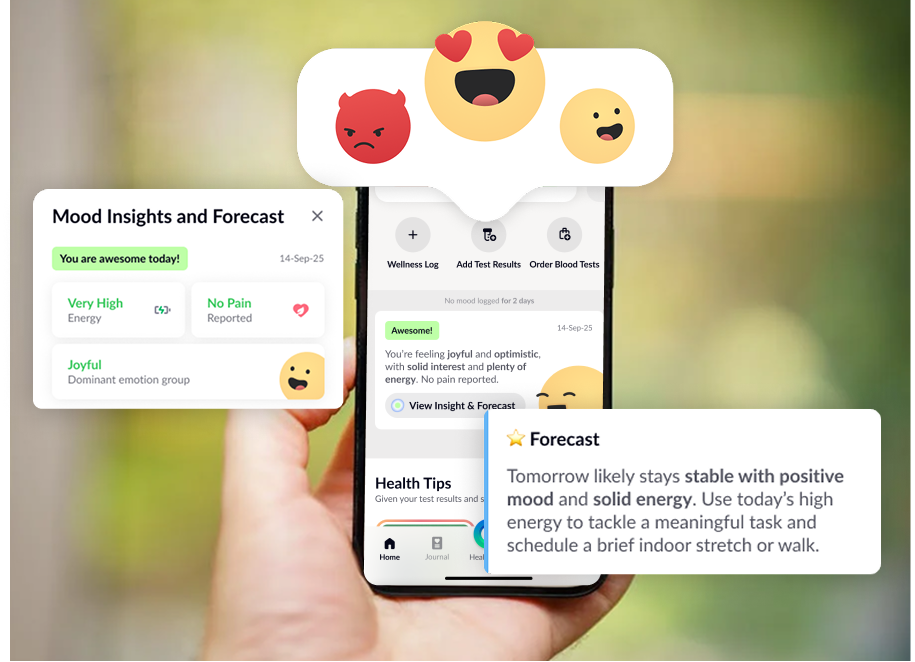
A mood diary can be much more than a chart of “good” or “bad” days. When built on a mindful and science-based approach, it becomes a tool for understanding yourself on a deeper level. The right kind of mood diary helps you stay aware of how stress shows up in your day-to-day feelings — while uncovering the habits and factors that sustain your wellbeing.
Let’s explore the three essential traits that make a mood diary truly effective: helping you develop emotional intelligence, recognize emotional patterns, and build resilience against stress.
1. Mood Diary Through Emotions — Learning to Understand Yourself
The foundation of any mood diary lies in the way you assess your emotions. Most apps and journals offer a quick choice of smiley faces to describe how you feel — from “great” to “awful.” This method is convenient because it’s fast and simple. You can often add a short note or select factors that influenced your mood. So, what’s wrong with that?
The problem hides in its very convenience. Choosing a smiley takes only a second — which means you rarely stop to reflect on what you actually feel. Without conscious reflection, you lose the main therapeutic benefit psychologists emphasize: you don’t learn to recognize and name your emotions.
IN THIS ARTICLE
RELATED ARTICLES
Another issue with this quick approach is that people who tend to think in extremes (“everything is great” or “everything is terrible”) will see a distorted emotional picture in their mood diary. Over time, many of them give up tracking altogether because they can’t see the value. To move beyond such superficial evaluation, it’s better to record your mood by choosing specific emotions rather than faces. Why is an emotion-based mood diary more effective?
Imagine trying to describe your “normal” day with a single smiley. You’d probably pick a happy face. But in emotional terms — does “normal” mean calm and peaceful? Or curious and joyful? Maybe it’s closer to tiredness, or even a hint of anxiety?
When you start identifying and naming emotions, you naturally tune in to your body — noticing whether you feel tension, lightness, relaxation, or a subtle tremor. This is what true emotional awareness means: connecting your feelings with your bodily sensations.
It’s also important to notice not only the dominant emotion but the quieter, background ones.
That’s why a good mood diary should not only help you name your emotions but also mark their intensity. That’s when it becomes a tool for genuine self-discovery — giving you personal insights you can choose to share in well-being conversations1.
📍 An emotion journal works as:
– a tool for self-reflection, helping you externalize your experiences, look at them from a distance, and begin an honest dialogue with yourself;
– a way that can help you become more aware when stress may be building up;
– a practice of emotional acceptance, helping you notice and process emotions instead of suppressing them, so you feel steadier through tough moments;
– a path to holistic awareness, where over time, your entries stop being just notes of pain or quick judgments and start reflecting the full complexity of your emotional world.
Psychologists call this the development of emotional literacy — the first step toward inner resilience.
Why Healsens?

Healsens — a Smart Approach to Longevity
Harness technology to extend your healthspan: biomarkers, risk assessment, and personalized recommendations—all in one place.
🔗 Download Healsens and take control of your health today.


» Tired and overwhelmed? Check your allostatic load — the science of stress impact.
2. Energy — The Key to Understanding the Depth of Emotions
Mood is not just about emotions — it’s also about the energy with which those emotions are felt. Anxiety with high energy feels like inner agitation, restlessness, or the urge to act. But anxiety with low energy feels very different — it’s exhaustion, helplessness, or quiet panic when strength is fading.
The same applies to joy: with high energy it becomes excitement and inspiration, while with low energy it transforms into calm contentment.
That’s why it’s so important that your mood diary doesn’t only capture emotions but also helps you notice how energized you are at any given moment. This awareness can support everyday stress management and balance.
When anxiety arises with high energy, your sympathetic nervous system switches to full alert.
Your body perceives the situation as a threat:
– cortisol levels rise,
– adrenaline and insulin flood the bloodstream,
– heart rate accelerates, muscles tighten, the body is ready to fight or flee.
In this state, your body doesn’t need meditation or calming techniques — it needs to release the stored energy. Movement is the best medicine: walking, exercise, deep breathing with long exhales, or any physical activity that helps discharge tension.
But anxiety with low energy is another story. Here, the sympathetic system is drained — cortisol may stay elevated or, conversely, drop too low, while the nervous system shifts into energy-saving mode. You might still feel anxious, but without the strength to act — as if everything has slowed down and your thoughts remain restless, yet you can’t bring yourself to move.
This is your body’s biological signal: your resources are running out.
In this case, physical exertion will only worsen the fatigue. What you need instead is restoration:
gentle breathing practices, meditations such as Kirtan Kriya, supportive social contact, rest, restorative sleep, and nourishing food that replenishes your energy.
📍 Key takeaway:
By tracking how your energy level changes throughout the day, week, or month, you can begin to see when you feel most active and when you’re depleted — and learn to choose the right self-regulation practices.
This kind of awareness, supported by a well-designed mood diary, helps you notice when you’re running low, manage everyday stress more mindfully, and choose restorative habits before fatigue builds.
Follow us on Facebook|| Instagram || Telegram || Youtube
3. Turning Observations into a System: The Two-Dimensional Mood Diary Model
Once you’ve learned to recognize and name your emotions (see chapter 1) and to sense your energy level (chapter 2), it’s time to take the next step — to bring structure to your reflections.
The simplest way to start is with a handwritten mood diary. You can use a printed list of emotions — for example, from psychological scales — and record what you feel each day along with your current level of energy. This helps you build awareness and start noticing emotional patterns.
However, the most effective way to track your emotional states is by using a digital mood diary. Modern tools — like the Healsens mood diary or other advanced mood diary apps — are based on two-dimensional models of mood that allow you to assess your emotional state in two key dimensions:
– Valence — how pleasant or unpleasant your emotion feels.
– Energy (Arousal) — how activated or drained you are at the moment.
This structure follows psychologist James Russell’s Circumplex Model of Affect, which demonstrates that emotions cannot simply be classified as “good” or “bad.” What truly matters is how they are experienced.
When you start using a mood diary built on this two-dimensional model, you create your own personal emotional map. Every emotion — from calm satisfaction to anxious excitement — can be placed within this emotional space. By tracking your mood in a mood diary, you can visualize not only peaks and lows but also patterns that repeat over time.
Such insights make your mood diary more than a log of feelings — it becomes a structured system for understanding your emotional life and the subtle dynamics that shape it. With regular use, a mood diary helps transform self-observation into emotional literacy — the foundation of mental stability and resilience.
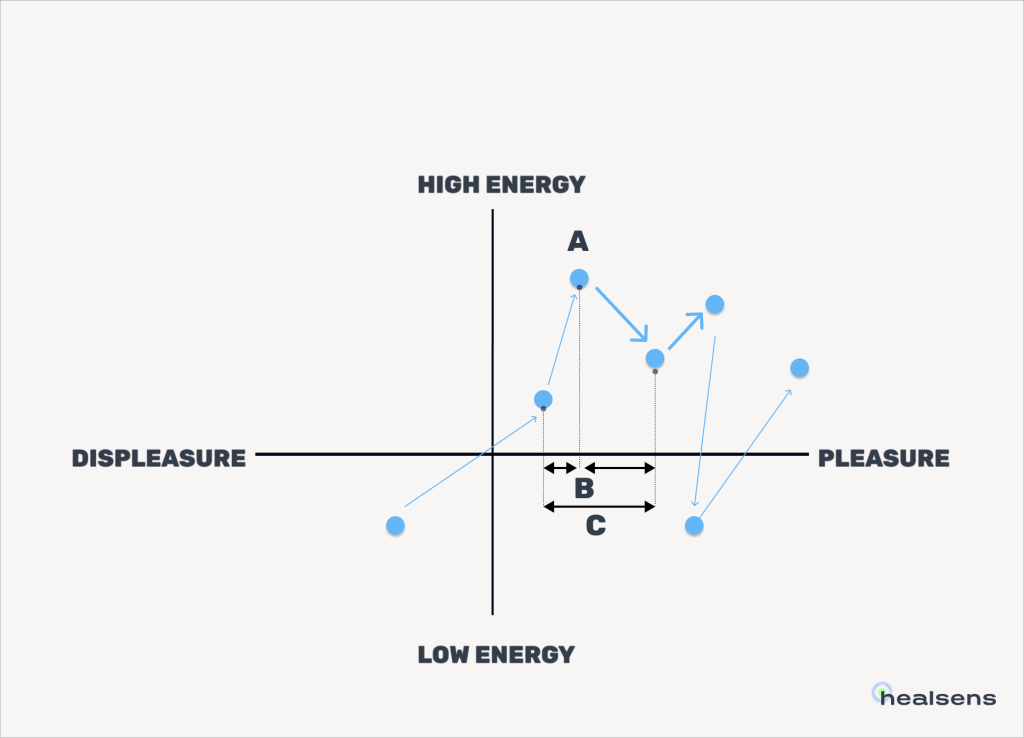
When you use a mood diary built on this two-dimensional model, you start noticing:
– where your mood tends to stay on the emotional map;
– how much your emotional state fluctuates;
– when you truly rest — and when you simply “switch off.”
Over time, these points form a trajectory of your mood — a line that shows how your emotional state moves through different phases. For some people, the path is smooth and centered in one area; for others, it swings widely across the full range of emotions.
Studies show that these trajectories reflect not only your current wellbeing but also deep personality traits and coping patterns.
A well-designed mood diary helps you see how your emotional and physical states interact, and where the limits of your inner resources truly lie.
📍 Why it matters:
– It helps you distinguish between fatigue and apathy, anxiety and overstimulation, sadness and recovery.
– It reveals when your energy begins to drop, allowing you to adjust your rhythm before burnout sets in.
– It transforms self-observation from merely describing emotions into an active tool for managing your state and understanding your emotional patterns.
By tracking your feelings in a mood diary, you build a bridge between awareness and action — learning not just to record emotions, but to interpret them, respond to them, and ultimately live with greater balance and self-understanding.
» Wondering why you should calculate your biological age? These 5 reasons will convince you to do it now.
🧭 How to Use the Mood Diary in Healsens
In Healsens, your mood diary is part of a broader picture of your health. A check-in takes only a few minutes, but instead of simply recording that “the day was fine,” you capture much more useful information: which emotions you felt, how intense they were, how much energy you had, and what was happening at the time.
1. Choose the emotions you’re feeling right now
On the main screen, tap Diary → Mood. You’ll see a list of emotions such as joy, calmness, anxiety, sadness, irritation, inspiration, and many others.
You can select more than one emotion at a time. This matters because our emotional state rarely consists of just one feeling. You might feel happy about an outcome, for example, while also feeling anxious about what comes next.
If you’re not sure what you’re feeling, you can use the built-in Healsens AI. Through a few simple questions, it helps you pay closer attention to your experience and narrow down the emotions that may describe it best.
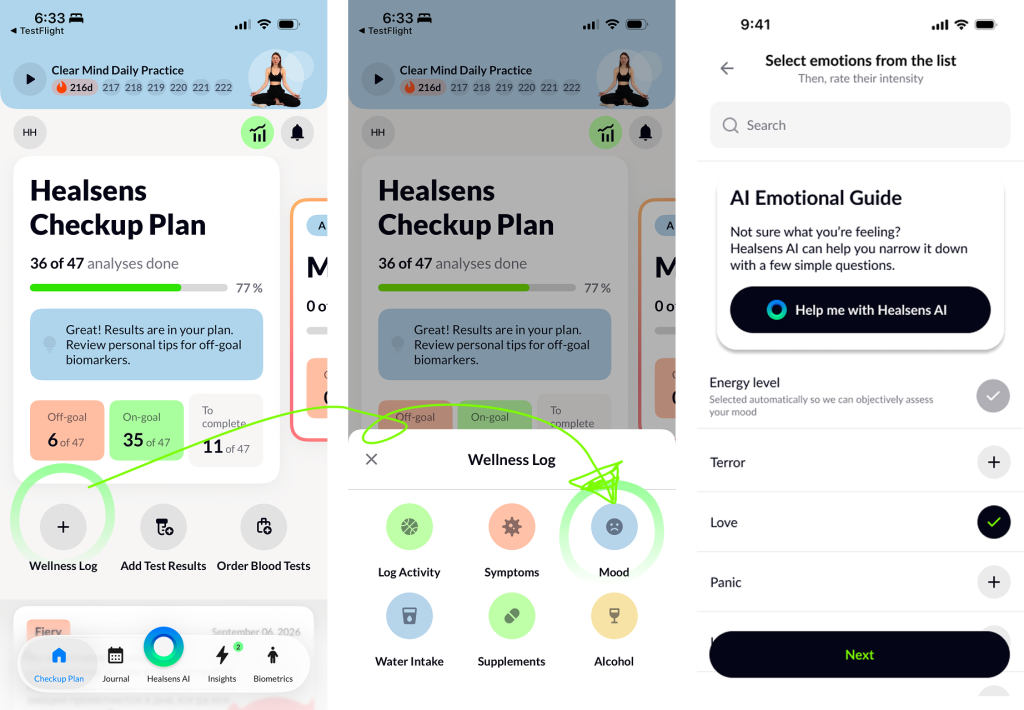
Not sure what you’re feeling?
Healsens AI can help you explore your emotional state with a few simple questions. Already have a sense of what you feel? Use the Healsens Emotion Wheel to compare similar emotions, find more precise words for your experience, and develop greater emotional granularity2..
This combination makes Healsens more than a conventional mood diary: it works as an AI mood tracker and emotional granularity app, helping you move beyond broad labels such as “good,” “bad,” or “stressed.”
2. Add your energy level and emotion intensity
Next, Healsens asks you two questions.
First, how much energy do you have right now? Here, energy reflects your level of activation — from feeling completely depleted to feeling highly energized or activated.
Then, rate how strongly you feel each emotion you selected.
This is where a mood diary entry becomes much more informative than a simple emoji or mood score. “I feel anxious” tells only part of the story. Intense anxiety with high energy and mild anxiety while completely depleted can be very different emotional states and may call for different approaches to self-regulation.
By tracking both emotion intensity and energy / activation, Healsens can preserve more of the nuance of how you actually felt.
3. Add context — if it matters
Before saving your check-in, you can add a note about what was happening.
For example:
“Slept badly because of nightmares and felt exhausted in the morning, but the situation was resolved by lunchtime.”
Adding context is optional, but over time these details can become especially useful. Instead of simply seeing that your mood changed, you can start looking for possible connections: what tends to happen before anxiety appears, after which kinds of days your energy drops, and what usually helps you feel better.
Healsens can also take this context into account when generating personalized insights and recommendations.
4. Get an interpretation of your current state
Once you save the entry, it appears on the main screen. Healsens looks at the combination of your emotions, their intensity, and your energy level and gives you a brief interpretation of your current emotional state.
Tap View detailed analysis to see a more detailed interpretation and suggestions for self-regulation.
These may include simple actions matched to your current state, such as rest and recovery, movement, breathing or meditation practices, and other ways to reduce tension or support emotional regulation.
📊 One mood diary entry is useful. The real value emerges over time
A mood diary becomes much more valuable when individual check-ins begin to form a history.
Tap the green chart button next to the bell to open your weekly report. There you can see, for example:
your overall mood for the week; how it changed compared with the previous week; how many days were dominated by pleasant or unpleasant emotions; which emotion appeared most often; and how stable your emotional state was.
If today you record “sadness + high energy,” that is just one data point. But if, after several weeks, you notice that sadness and irritation repeatedly appear after poor sleep or on particular days, you now have a hypothesis you can explore.
Over time, the diary becomes more than a place to record how you feel. It allows you to track mood and energy across weeks, months, and years, look for recurring patterns, and see whether lifestyle changes or the strategies you try are actually associated with feeling better.
You can explore these patterns yourself, discuss them with Healsens AI, or share the data with a psychologist or doctor if you’re tracking mood as part of your mental health care.
If you’re looking for the best AI mood tracker for your needs, it is worth looking beyond apps that simply ask you to rate your day from 1 to 5. A useful mood tracker should help you capture the nuances of your emotional experience and make those observations meaningful over time. That is the approach behind the Healsens mood diary.
Start with one check-in today. Don’t try to find a pattern immediately — simply record your emotions, their intensity, your energy level, and a little context. After a few weeks, those individual data points can begin to form your own personal map of mood and emotional patterns.
FURTHER READING
Source: ©️2019 Healsens B.V. All right reserved