

Personalized Reference Intervals (prRI) in Healsens
Healsens uses longitudinal blood test history to estimate personalized reference intervals (prRI) for supported biomarkers.
A personalized reference interval is derived from an individual’s own previous laboratory results and expected within-person and analytical variation. It is shown separately from the laboratory reference range and the Healsens Goal.
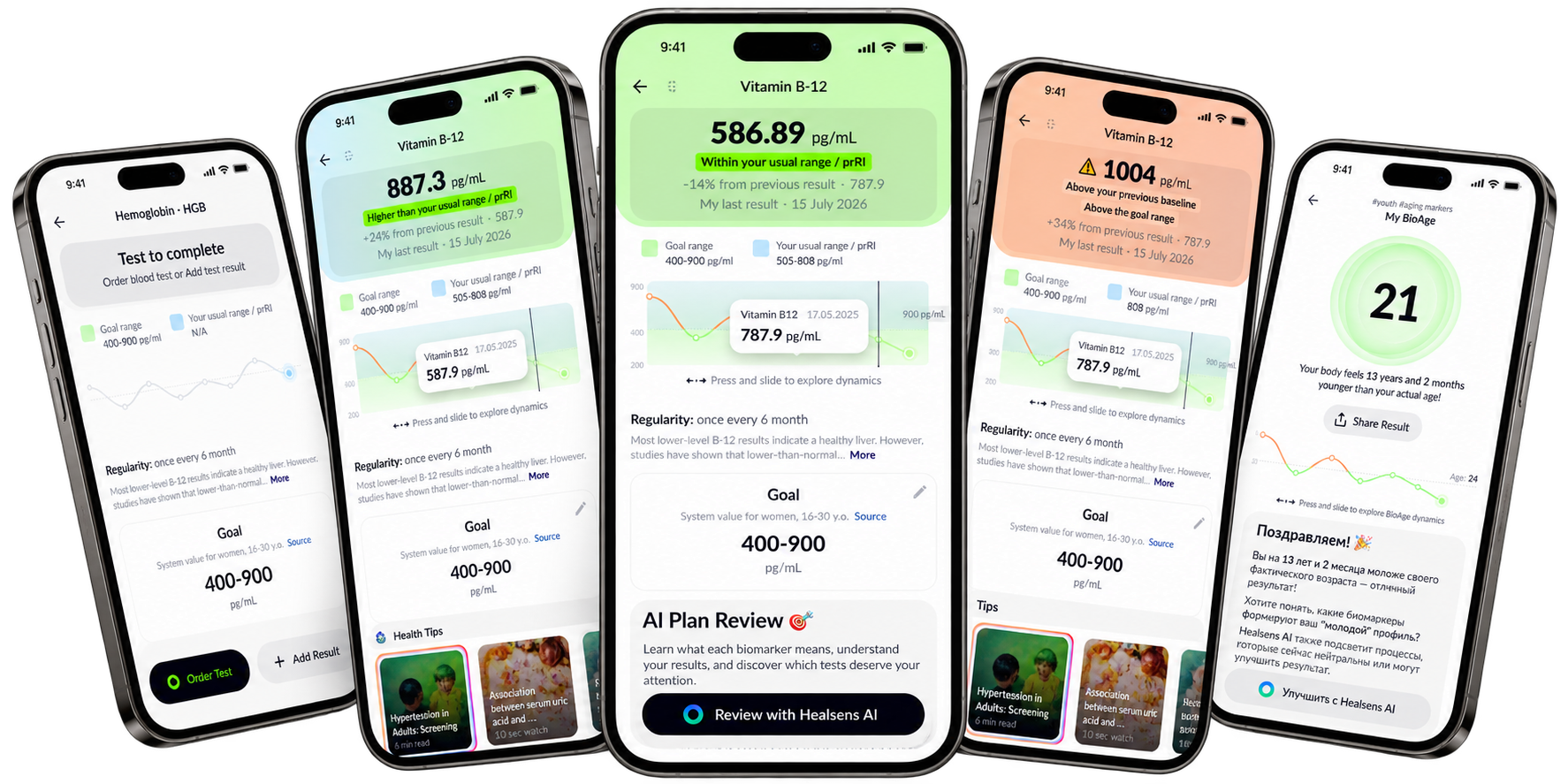

How personalized reference intervals (prRI) works
Most laboratory results are compared with a reference interval provided by the laboratory. Healsens adds another layer: your own longitudinal blood test history.
For supported biomarkers, Healsens can use previous comparable results to estimate a personalized reference interval (prRI) — a range that reflects where that biomarker has typically been for you.
The model considers previous measurements together with expected within-person biological variation and analytical variation. As more comparable results become available, your longitudinal history provides more information about your individual biomarker pattern.
This allows Healsens to distinguish between three different questions:
✔ Laboratory Reference Range: Is my result within the laboratory reference interval?
✔ Healsens Goal: Is my result within the personalized target range relevant to my health profile?
✔ Your usual range / prRI: Is this result usual for me based on my own previous results?
These ranges complement rather than replace one another.
Personalized reference intervals (prRI) vs Laboratory Reference Range
A laboratory reference interval is the range reported by the laboratory alongside a test result. It is established or verified for the laboratory’s population, method and analytical system.
A personalized reference interval (prRI) uses the individual’s own longitudinal laboratory history to provide an additional, person-specific point of comparison.
This matters because two people can both have results within the same laboratory reference interval while having very different individual patterns.
For example, a laboratory reference interval might be 400–900, while one person’s previous results consistently fall between approximately 500–600. A new result of 700 may still be within the laboratory reference interval but may be unusually high relative to that person’s previous results.
A prRI does not mean that a value inside the personal range is necessarily healthy, and a value outside it does not by itself indicate disease. It provides additional context for interpreting change over time.

Spot changes earlier
A result can still fall within the laboratory reference range while being unusual compared with your own previous results.
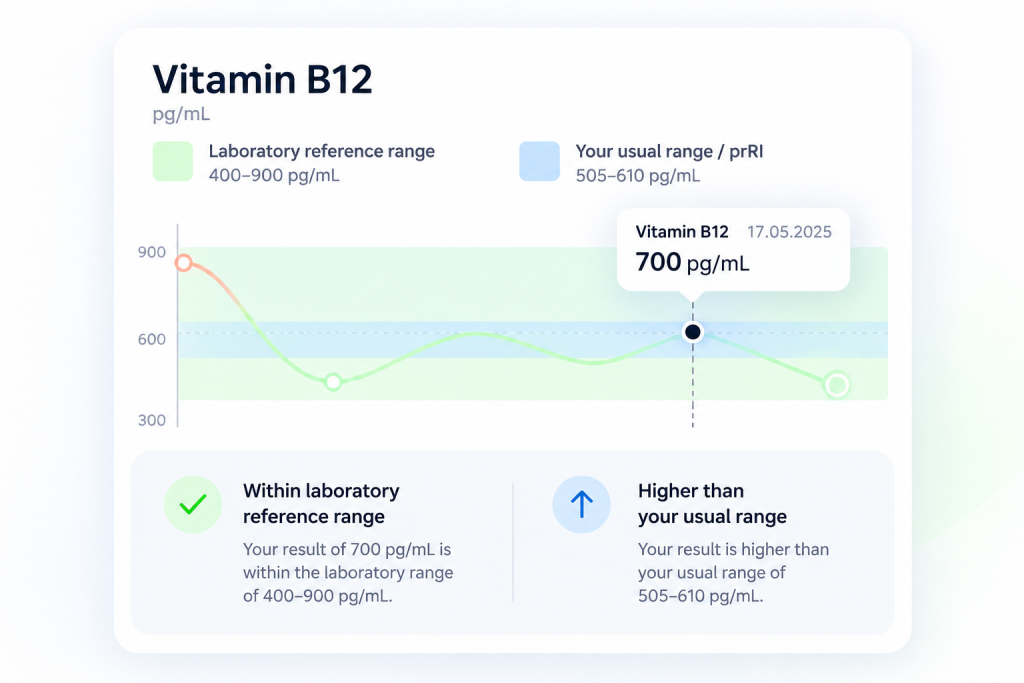

Know what is usual for you
Your previous results can reveal a narrower, individual biomarker pattern that a population-based reference range cannot show.
prRI vs Healsens Goal
Healsens Goal and prRI are not the same thing.
Healsens Goal answers:
“Where would we ideally want this biomarker to be?”
Depending on the biomarker, Healsens Goals may be personalized using relevant characteristics such as age, sex, lifestyle, health conditions and other health context.
Personalized Reference Interval (prRI) answers a different question:
“Where has this biomarker typically been for me?”
It is derived from the individual’s own longitudinal test history rather than only from characteristics of similar people.
This distinction is important. A biomarker can be within your usual range but outside your Goal. This may indicate that an undesirable level is nevertheless typical for you.
The reverse can also happen: a result can be within your Goal but outside your usual range. In this case, the value may still be within the desired target while representing an unusual change relative to your own history.
| Healsens Goal | prRI / Your usual range | |
|---|---|---|
| Main question | Where should I ideally be? | What is usual for me? |
| Based on | Relevant health characteristics + evidence | My own longitudinal results + variation |
| Can change meaningfully | As health context changes | As sufficient longitudinal evidence accumulates |
| Means “healthy”? | Target-oriented | No — usual ≠ optimal |
How many previous results are needed for a personalized reference intervals (prRI)?
There is no single number of previous results that is appropriate for every biomarker and every statistical method.
Published prRI models have shown that three or more previous results obtained during a steady state can provide useful personalized intervals when reliable estimates of analytical and within-subject biological variation are available. Other approaches require at least five previous measurements when estimating individual variation from the person’s own data.
Healsens therefore does not treat the number of results alone as sufficient. The system also considers whether previous measurements are comparable and whether the history appears sufficiently stable to estimate a meaningful personal range.
When there is not enough suitable history, Healsens can continue to show the laboratory reference range and Healsens Goal while the personal range remains unavailable.
The more high-quality comparable results you add over time, the more longitudinal context Healsens has available.

See when your baseline shiftsp
One unusual result may be temporary. A series of results can show when your usual biomarker pattern is actually changing over time.


Make your test history more useful
The more comparable results you keep together, the more context you have for understanding future changes.

What happens when a result is within the Goal but outside your usual range?
This is one of the main reasons to analyze blood test results longitudinally.
Imagine:
Healsens Goal: 400–900
Your usual range: 505–610
Your latest result: 700
The result is still Within Goal.
But compared with your own previous results, Healsens can identify it as:
Higher than your usual range.
This does not mean that the result is dangerous or that a disease is present. It means that something has changed relative to your established individual pattern.
Depending on the biomarker and context, such a change may be worth monitoring, repeating, or discussing with a healthcare professional.
Traditional single-result interpretation can answer whether the result is inside a reference or target range. Longitudinal biomarker tracking adds another question: is this result unusual for me?
Scientific basis and references
Healsens prRI is informed by research in biological variation, personalized reference intervals, longitudinal laboratory interpretation, and precision laboratory medicine.
1. Personalized Reference Intervals in Laboratory Medicine: A New Model Based on Within-Subject Biological Variation
Coşkun A, Sandberg S, Unsal I, et al. Clinical Chemistry. 2021;67(2):374–384.
The study proposes a model for calculating personalized reference intervals using an individual’s previous test results together with analytical variation and within-subject biological variation. In patients considered to be in steady state, ≥3 previous measurements produced robust personalized reference intervals.
PubMed · DOI: 10.1093/clinchem/hvaa233
2. A Parametric Empirical Bayes Approach to Personalized Reference Intervals and Reference Change Values
Røys EÅ, Viste K, Farrell CJ, et al. Clinical Chemistry. 2025;71(11):1147–1157.
Introduces an empirical Bayesian framework for estimating personalized reference intervals from a limited number of individual results by combining personal measurements with population information. The model was evaluated across nine biomarkers, including creatinine, cortisol and testosterone.
PubMed · Full article / DOI
3. Personalized Reference Intervals Versus Indirectly Estimated Population-Based Reference Intervals for Hematology Measurands
Demirelce O, Bercik Inal B, Coşkun A. International Journal of Laboratory Hematology. 2026;48(2):365–370.
Compared personalized and population-based reference intervals for 17 complete blood count parameters using longitudinal data from 200 healthy individuals. The study found substantial differences between personal and population intervals, although the magnitude varied considerably by biomarker.
PubMed · DOI: 10.1111/ijlh.70035
4. Personalized Reference Intervals for Biochemical, Hormonal, and Coagulation Tests: Comparison With Population-Based Reference Intervals
Kazar M, Aksit M, Colak A, İlhan Topcu D. Clinica Chimica Acta. Article published online July 2026; journal issue 2027;592:121220.
Extends prRI analysis across biochemical, hormonal and coagulation biomarkers. Personalized intervals were generally narrower than population-based intervals: 94.7% of calculated reference interval indices were below 1. The degree of individuality differed substantially by analyte; liver enzymes, creatinine, ferritin, thyroid hormones and lipids showed particularly high individuality, while population intervals remained informative for some other analytes. The authors also emphasize that clinical utility still requires further validation.
PubMed · DOI: 10.1016/j.cca.2026.121220
5. Personalized Reference Intervals Based on Biological Variation: A Critical Evaluation of Strengths and Limitations
Coşkun A, et al. Clinical Chemistry and Laboratory Medicine. 2026.
A recent critical evaluation of the strengths and limitations of biological-variation-based personalized reference intervals, placing prRI in the broader development of individualized laboratory interpretation.
PubMed · DOI: 10.1515/cclm-2026-0263