

The Essence of Emotions: Why Emotional Granularity Matters
We tend to think the essence of emotions lies in how we react to a situation: something happens, and the brain automatically produces the corresponding emotion — danger means fear, loss means sadness, unfairness means anger. But emotions are more complex than that. Appraisal theory, emotional granularity, and research on valence + activation (energy) offer a more nuanced way to understand what we feel — an approach we bring together in the Healsens Modern Emotional Awareness Wheel. To see why the same event can feel completely different to different people, imagine a manager sending the same message to four members of their team:
“Could we move tomorrow’s meeting to Friday?”
One thinks, “Great, I’ll have more time,” and feels relieved.
Another wonders, “Are they having doubts about the deal?” and feels anxious.
A third thinks, “They don’t value my time at all,” and becomes irritated.
The fourth thinks, “That’s a shame, I was really looking forward to this meeting,” and feels sad.
The event is exactly the same — the meeting has been postponed — yet it produces very different emotional experiences. Why?
What Are Emotions, in Simple Terms?
An emotion is more than a reaction to an event. It reflects how the brain makes sense of what is happening both around us and within us, drawing on context and past experience. Researchers have yet to identify a unique, objective physiological or neural “fingerprint” for each specific emotion1.
There is, however, broad agreement that an emotion, or emotional episode, is usually relatively short-lived and connected to a particular object, event, or meaning:
I’m angry with him for what he did.
I’m afraid of the conversation ahead.
I’m happy about the news.
A typical emotional episode may last seconds or minutes, and sometimes hours.
This distinction matters when we talk about emotional granularity. To understand an emotion more precisely, we need to go beyond simply noticing that we feel “good” or “bad” and begin to distinguish the particular emotional experience unfolding in response to what is happening.
RELATED ARTICLES
Mood, on the other hand, tends to last longer. It is more diffuse and often has no single obvious object:
“I’ve been in an irritable mood all day.”
An emotion, however, can be reactivated. Imagine that you have an argument in the morning. Four hours later, you think about it again and feel another wave of anger. Then something reminds you of what happened, and the anger returns once more. Subjectively, this may feel like “I’ve been angry all day,” when in fact it may be a series of emotional episodes sustained by thoughts, memories, and new triggers.
Another important concept is what psychologists call core affect. Think of it as a basic background state. We may not always notice it, much as we do not normally feel our body temperature, but it is continuously present in the background of our experience.
Core affect has two dimensions:
- valence: does the experience feel pleasant ↔ unpleasant?
- activation (arousal): low energy ↔ high energy.
This background state is present virtually all the time while we are awake. So a person may not yet be able to say:
“I feel anxious.”
But they may already sense:
unpleasant + high or low energy.
To understand what emotion lies behind that state, we draw on context + bodily sensations + past experience + concepts we have learned. Together, these clues can help us categorize the experience more precisely: “this is anxiety,” “this is irritation,” “this is excitement,” and so on.
This ability to move from a broad affective state to a more precise emotional category is an important part of emotional granularity.
Why Healsens?

Healsens — a Smart Approach to Longevity
Harness technology to extend your healthspan: biomarkers, risk assessment, and personalized recommendations—all in one place.
🔗 Download Healsens and take control of your health today.


» Tired and overwhelmed? Check your allostatic load — the science of stress impact.
What Is the Essence of Emotions?
An emotion is a situational category the brain uses to make sense of our current state and what is happening around us. So the essence of emotions is not simply to produce a feeling. Emotions help us evaluate the significance of what is happening while simultaneously adjusting the body, attention, thinking, and readiness to act.
Emotions also guide attention and shape how information is processed. In other words, the brain uses emotional categories to organize an enormous stream of incoming information.
Let’s look at an example. If the category of “anger” becomes active, the brain will begin to prioritize information that is relevant to anger. For instance:
Anger → violations of boundaries, unfairness, and obstacles become especially noticeable.
At the same time, this process helps filter out some of the information that is less relevant to the current state.
Put differently, the essence of emotions is to help us quickly determine what is happening, what it means for our goals and well-being, and adjust accordingly.
Imagine an animal that had to consciously reason every time a predator appeared:
“There is a large animal in front of me. Based on its speed and trajectory, the probability of physical harm is…”
Too late. 🙂
What is needed is a much faster system:
threat → attention to the threat → physiological mobilization → readiness to escape or defend.
In the theory of constructed emotion, emotions are also closely connected to allostasis (our regular readers will already be familiar with allostatic load). The brain does not simply react to events after they happen. It is constantly trying to anticipate the body’s needs and regulate its resources accordingly.
So, at its core, the essence of emotions is practical: to help us respond to situations quickly and effectively while regulating the resources our body may need.
» Tired and overwhelmed? Check your allostatic load — the science of stress impact.
Where Do Emotions Come From?
One of the most useful ways to understand where emotions come from is appraisal theory. A major review by Scherer & Moors in the Annual Review of Psychology describes the process roughly like this2:
event → appraisal of what it means → changes in readiness for action + physiology + attention/expression → subjective feeling → categorization/naming of the emotion.
Remember our example of the postponed meeting? The event itself is not yet an “emotional event.” The brain has to evaluate what it means for you.
But where does the very first signal come from?
The emotional system receives information from both outside and inside the body.
A 2025 review in the Annual Review of Psychology describes interoception3 — the brain’s perception of the body’s internal state — as a fundamental part of emotional processing. Heart rate, breathing, signals from internal organs, the autonomic nervous system, and other internal cues all contribute to our experience, together with the way the brain interprets them in the context of what is happening.
In simple terms, the brain is constantly working with:
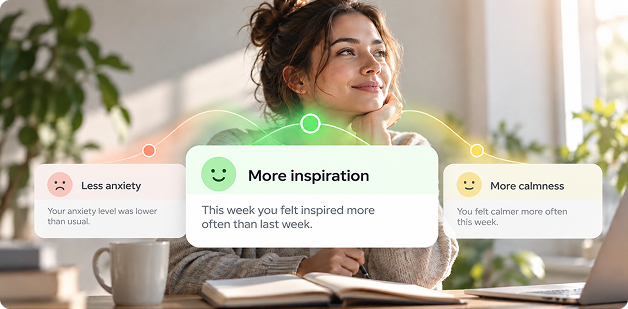
the body
→ what is happening inside me?
memory
→ what does this remind me of?
goals and needs
→ what matters to me right now?
predictions
→ what is likely to happen next?
the outside world
→ what is happening around me?
And all of these interact.
Here is a very simple example. You are walking down the street in the evening when suddenly, behind you:
BANG.
Before you have time for any lengthy conscious reasoning, your body may already shift into a state of mobilization:
heart rate increases → attention narrows → muscles prepare for action → arousal rises.
But what emotion is it? You turn around. If you see someone running toward you:
danger → fear → readiness to run or defend yourself.
If you see that your son has knocked over a trash can:
“Oh God…” → relief + perhaps some irritation.
If you realize it was a firework:
surprise → interest/joy.
In other words, physiological activation alone does not fully determine which specific emotion you experience.
This is also consistent with a recent neuroscience review in Trends in Cognitive Sciences. Researchers are still trying to understand exactly how physical signals from inside the body become subjective qualities such as arousal (activation/energy), pleasantness or unpleasantness, and ultimately an emotional experience. The authors emphasize that science still does not have a complete mechanistic explanation for how this transition occurs.
Why Is It Important to Name Our Emotions?
If the essence of emotions is to help us deal effectively with what is happening, why interfere with the process at all? Why do emotions sometimes seem to get in the way rather than help? And why should we learn to recognize exactly what we are feeling?
Naming an emotion more precisely is more than an exercise in vocabulary. Our response to an event often unfolds not as a simple chain, but as a loop:
situation → appraisal → emotion → shift in attention and perception → new appraisal → emotion is sustained or changes
In other words, an emotion is not simply the result of how we perceive a situation. Once it arises, it begins to influence what we notice and how we interpret what happens next.
For example:
event → “this is unfair” → anger → increased attention to signs of unfairness → more evidence supporting the original appraisal → anger is sustained.
This is why our ability to distinguish between emotions matters.
If someone describes their state very broadly — simply as “I feel bad,” for example — an enormous range of negative information can potentially fit that category: an irritating noise, a rude person, an unpleasant message, someone else’s aggression, a mistake of their own.
A more precise categorization — “I’m irritated,” “I’m disappointed,” or “I’m anxious” — narrows the category. Fewer things happening around us fit that particular emotional state and reinforce it.
One hypothesis explored in the research is that this mechanism may help explain why greater emotional granularity — the ability to distinguish more precisely between different emotional states — is associated with more flexible emotion regulation.
Awareness Wheel
The Healsens Modern Emotional Awareness Wheel is a tool designed to help you move from a broad sense of “I feel good” or “I feel bad” toward a more precise understanding of what you are feeling — and what that feeling may be connected to.
What makes the wheel different is that it brings together three distinct levels.
1. Your basic state — pleasant or unpleasant (valence) + energy (activation).
You do not need to know the name of the emotion right away. You can start with two much simpler questions: Does this feel more pleasant or unpleasant? Do I have high or low energy? This corresponds to the idea of core affect we discussed earlier.
2. What the situation might mean to you.
The next layer does not name emotions. Instead, it offers possible directions to explore: threat, uncertainty, loss of control, social evaluation, unfairness, comparison, connection, possibility, action…
In other words, it helps you ask:
“What might matter to me in this situation?”
There is an important distinction here: these are not emotions. They are clues to what may feel important to you right now. This prevents the wheel from falling into overly simple formulas such as “anger always means that a boundary has been crossed.”
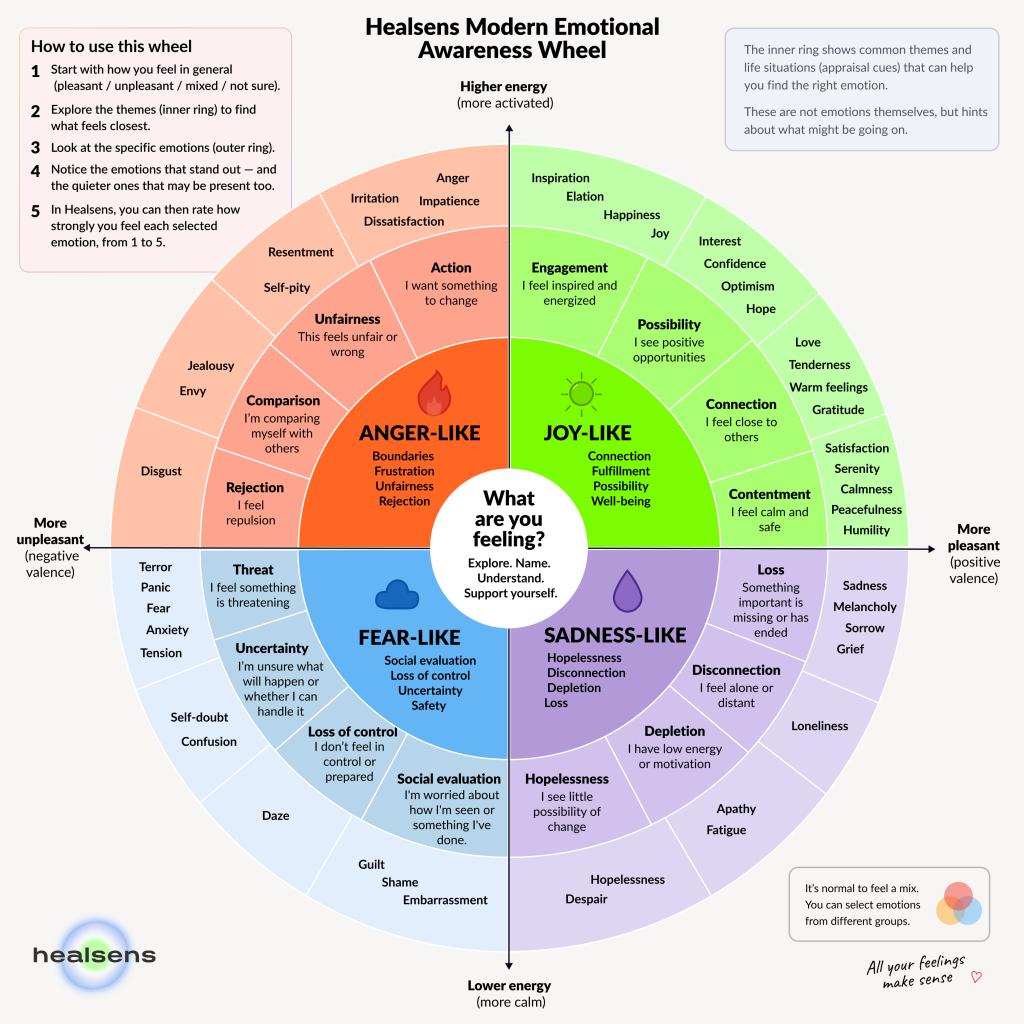
3. A more precise emotional category.
Only then do you move toward specific words: irritation, frustration, jealousy, anxiety, confusion, guilt, loneliness, sadness, hope, tenderness, serenity, and so on.
The main purpose of the wheel is to guide you through a process:
“What’s going on with me?” → “What is my general state?” → “What matters to me here?” → “Which emotion best describes my experience?”
In this way, the wheel can help build emotional granularity — moving from a broad affective state toward a more differentiated emotional experience. In the Healsens app, we add two dimensions that are not shown directly on the wheel: emotion intensity and the ability to record several emotions occurring at the same time.
In the app, this process is also supported by the AI Emotional Guide. It is not a tool that “decodes” your feelings or tells you what they mean. When you are struggling to name what you feel, it can ask guiding questions or suggest words within the same emotional space, drawing on valence, energy, and what may be significant in the situation.
The guide does not decide for you or diagnose you. Its purpose is simply to make emotional granularity easier when all you can come up with at first is “I feel bad” or “I feel tense.”
Most importantly, Healsens does not decide what you are feeling — and cannot tell you what you “really” feel. You are always the one who decides what fits your experience.
Frequently asked questions about emotions
What is an emotion in simple terms?
An emotion is a relatively brief experience tied to a specific situation or what that situation means to you. Unlike mood, an emotion usually has a clear object: “I’m angry at him,” “I’m afraid of the conversation,” “I’m happy about the news.” Your brain uses emotion to quickly assess what’s happening, then shift attention, body state, and readiness to act.
What is the essence of emotions?
The essence of emotions is to evaluate how much what’s happening matters for your goals and wellbeing, and to reorganize attention, the body, and action readiness. Emotions also help the brain filter information: when anger is active, you notice boundary violations and unfairness more; when anxiety is active, threats and uncertainty stand out more.
Why does the same event cause different emotions in different people?
Because of appraisal theory: emotion depends not only on the event, but on how the brain evaluates its meaning—threat, loss, injustice, relief, opportunity, and so on. One message about rescheduling a meeting can trigger anxiety, irritation, sadness, or relief, depending on what it means to each person in that moment.
How is an emotion different from a mood?
Mood usually lasts longer, feels more diffuse, and is less tied to one event (“I’ve been irritable all day”). An emotional episode is shorter and more often linked to something specific. The same conflict can trigger several emotional spikes through the day via thoughts and reminders—so it can feel like “anger all day” even though it’s a series of episodes.
What are valence and activation (energy) in emotions?
Valence is how pleasant or unpleasant an experience feels. Activation (arousal, energy) is how mobilized your body and nervous system are—from calm to highly aroused. Together they form core affect, a background state that’s present much of the time you’re awake, often before you name a specific emotion. Anxiety and anger can both feel “bad,” but they often differ in energy—which is why good/bad mood tracking misses part of the picture.
What is emotional granularity?
Emotional granularity is the ability to tell similar states apart—not just “I feel bad,” but “I’m anxious,” “I’m irritated,” or “I’m disappointed.” More precise labeling narrows what your brain treats as relevant and is linked to more flexible emotion regulation. Emotion also loops: appraisal → emotion → changed attention → new appraisal.
What is the Healsens Modern Emotional Awareness Wheel?
The Healsens Modern Emotional Awareness Wheel is an emotional awareness tool that moves from a general “good/bad” feeling to a more precise label in three steps: (1) valence and energy, (2) what might matter in the situation (threat, uncertainty, injustice, closeness, opportunity—not emotions, but cues about significance), (3) a more specific emotion word. The Healsens app adds intensity and the option to log several emotions at once, without deciding what you “really” feel—you choose what fits.
What is the Healsens AI Emotional Guide?
The Healsens AI Emotional Guide helps you narrow emotional labels—it doesn’t decide what you truly feel. When it’s hard to name a state, it can ask clarifying questions or suggest words from the same framework (valence, energy, situational meaning). It isn’t therapy or a diagnosis; it supports more accurate self-tracking in the mood journal. You can accept, change, or reject any suggestion.
Where do emotions come from, according to science?
Many models describe a chain: event → appraisal of meaning → changes in body, attention, and action readiness → subjective feeling → emotion label. Interoception (signals from the body), memory, goals, expectations, and context all play a role. Science doesn’t have one fixed “fingerprint” for each emotion in the brain or body—emotions are better understood as situational categories the brain builds to organize experience.
Healsens AI Emotional Guide helps narrow emotional labels without deciding what you truly feel.
FURTHER READING
Source: ©️2019 Healsens B.V. All right reserved