

From Tracking to Transformation: How Doctors Use Wearable Data in Clinical Practice
Wearable devices now ship in the hundreds of millions each year, and many people carry a tracker capable of monitoring their heart rate, sleep stages and regularity patterns, and daily step count. Fitness rings, smartwatches, and continuous glucose monitors generate vast streams of physiological data. At the same time, direct-to-consumer lab testing can allow people to order common panels without a traditional clinic visit. In Finland, MRI scans are now accessible by private imaging providers without a traditional doctor’s checkup prior. Health tracking, in other words, has never been more accessible. How doctors use wearable data in clinical practice — and what the evidence tells us. Let’s explore both real-world clinical experience and the research behind it.
Yet evidence suggests that data alone is usually insufficient to change behaviour at scale. A large umbrella review of systematic reviews found that wearable activity trackers significantly increased daily step counts and overall physical activity across diverse populationsef1. Despite rapid adoption, the public-health impact of these tools depends on whether data is translated into sustained behaviour change and clinical action. The bottleneck is not a lack of data — it is a lack of meaningful context.
About the Author: Dr. Antti Rintanen is a licensed medical doctor from Finland and former world champion in Taekwon-Do, with a strong interest in translating medical knowledge into clear, practical guidance for everyday life. He writes at drantti.com, where he covers a wide range of topics from exercise physiology and biomechanics to preventive health, recovery, and evidence-based lifestyle medicine.
How doctors use wearable data becomes clear in daily practice: a large proportion of my patients have some form of smart device that tracks their health. One may wear a ring that measures heart rate variability and body temperature, another might wear a bracelet that measures step count, and another a smartwatch that measures ECG in real time. These devices are already shaping clinicians’ decision-making. They can prompt people to discuss their wellbeing with a healthcare professional, who can decide if any clinical follow-up is needed.
Why Health Data Needs Context
Consumer health tracking has outpaced clinical interpretation. Digital health interventions designed to enhance primary prevention have proliferated rapidly, yet a comprehensive scoping review shows that their implementation and integration with clinical workflows varies widely, with substantial heterogeneity in how decision-support tools and electronic records are used in practice2. The result is a familiar pattern: patients accumulate months of step-count data, sleep scores, and resting heart rate trends, but arrive at their annual check-up unable to translate any of it into a meaningful clinical question.
A systematic review published in the Journal of Medical Internet Research found a positive association with improved engagement across several dimensions — including treatment adherence, self-management, and health outcomes — but noted significant usability concerns and barriers that limited benefit in a substantial proportion of users3. Access, it turns out, is necessary but not sufficient. Many people benefit from simple, easy-to-understand summaries that help them discuss their lifestyle with a professional if they choose.
RELATED ARTICLES
I see this pattern frequently in my practice. Some of my patients collect a lot of data about themselves, but they don’t have the skills to interpret the data. Just as importantly, they lack the right tools to make the right interventions. For example, a patient whose device reports poor sleep quality or low heart rate variability starts to monitor the indicators more closely, gets stressed about sleeping and paradoxically can’t sleep, making the situation worse. The dynamics are analogous to a situation familiar to doctors where a patient goes to have himself/herself imaged without a professional’s indication for examination, which might lead to overtreatment and iatrogenics.
Understanding Personal Health Risk
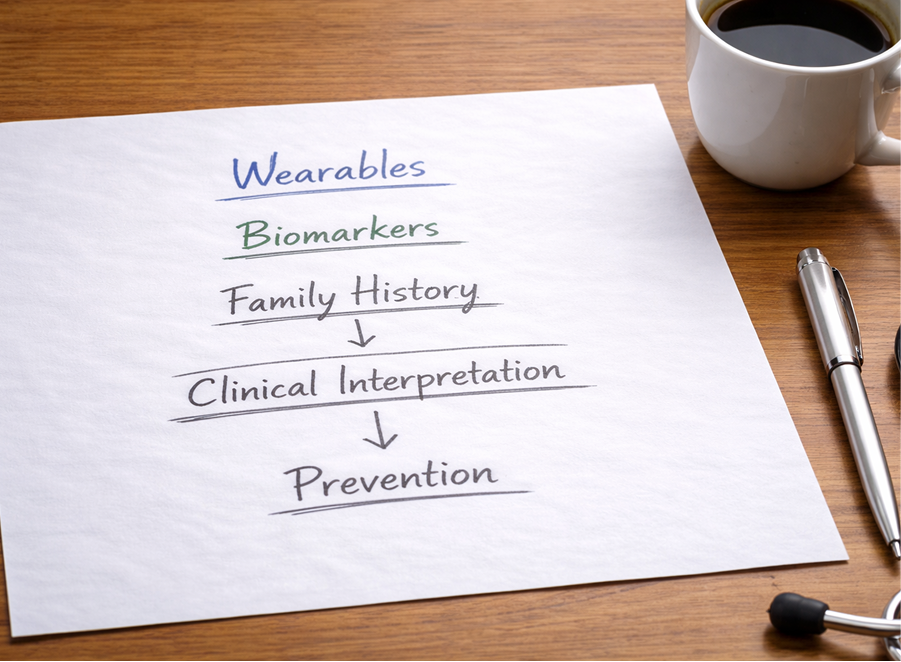
Meaningful risk assessment draws on three distinct data streams: lifestyle and wearable data, clinical biomarkers, and family history. Each adds a different dimension and none is sufficient on its own.
Recent large-scale research has clarified what wearable data can contribute. In the NIH All of Us Research Programme, Master and colleagues linked Fitbit step-count data to electronic health records across 6,042 participants monitored over a median of 4.0 years, accumulating 5.9 million person-days of tracking. They found generally inverse associations between daily step count and incident chronic disease — with largely linear associations observed for obesity, sleep apnea, gastroesophageal reflux disease, and major depressive disorder, while diabetes and hypertension showed nonlinear relationships with risk plateaus at higher step counts4.
Biomarkers add the next layer. Cholesterol values, blood glucose, inflammatory markers, and blood pressure measurements translate behavioural patterns into measurable physiological risk. These measurement parameters are a standard part of general practice and are part of the routine test battery of almost every patient I evaluate. Their importance is supported by decades of population research. Recent evidence suggests that multimarker approaches may improve risk prediction beyond single biomarkers and help refine individual risk stratification, potentially supporting more personalised prevention strategies5. In my home country, Finland, cardiovascular mortality was once among the highest in the world, which prompted large national prevention efforts. Programmes such as the North Karelia Project6 and the FINRISK [10] studies demonstrated how systematic monitoring and reduction of these core risk factors can translate into substantial declines in cardiovascular mortality at the population level.
Family history is perhaps the most underused risk variable of all. A study drawing on Framingham Heart Study data found that parental history of cardiovascular disease raised offspring risk substantially — conferring approximately a 71% (HR 1.71, 95% CI 1.33–2.21)
higher hazard of future cardiovascular events7. Parental obesity and smoking history independently further elevated risk. Standard calculators such as SCORE2 [6] do not formally incorporate detailed family history as an input variable, creating a systematic blind spot that clinicians and patients must actively compensate for. In contrast, some national risk models — like the FINRISK8 calculator we use in Finland — do incorporate family history, highlighting its recognised importance in long-term risk assessment.
It is therefore important to understand the limitations of digital health data alone. It is only suitable as a complementary part of the whole, and does not replace the influence of biomarkers and family history in the comprehensive assessment of a patient’s risk profile.
» Wondering how cardiovascular risk is assessed in real life? Here’s a guide to the most common clinical risk calculators.
How Doctors Use Wearable Data: Turning Tracking Into Action
Understanding risk is only useful if it leads to action. This is ultimately how doctors use wearable data in practice — not as isolated numbers, but as part of a structured clinical framework. Personal data can help frame general wellbeing goals; a healthcare professional can decide whether any medical action is appropriate. Some wellness platforms, such as the Healsens smart health journal, help people organize their lifestyle information for general guidance and conversations with professionals. This is what I do together with my patients. We review their self-tracking information alongside personal background to set broad wellness goals they can discuss with their doctor.
There isn’t yet a common consumer-friendly way to summarize all these wellness signals into one simple score. The closest examples are traditional risk calculators such as FINRISK [10], which combine established clinical factors, but they do not incorporate continuous personal health data. As a result, risk assessment in practice still relies mainly on biomarkers and family history, while digital health data are interpreted separately. This is not because integration is impossible, but because personal health data are not yet sufficiently standardised or validated for use in population-level prediction models.
Despite this, wearable data can still provide powerful clinical insight when interpreted appropriately. Within this framework, wearable data plays a specific role. Its value lies less in individual readings than in longitudinal patterns. Evidence from the All of Us programme illustrates this clearly: participants with higher daily step counts — the cohort’s median was 7,731 steps per day — showed lower incidence of several chronic conditions across follow-up [5], while irregular sleep patterns over time were associated with higher cardiometabolic and psychological risk profiles9. Neither finding would be detectable from a single measurement; their prognostic value lies in the pattern over time.
Digital wellness data can provide helpful context for lifestyle discussions and healthy habit planning. In the future, as digital health data become more standardised and validated, they may be incorporated into population-level risk models alongside traditional clinical factors. This could allow clinicians to estimate risk more precisely and tailor preventive plans with greater individual detail.
Learn more about our wellness tracking app on Google Play.
Collaboration Between Patients and Clinicians
As patients arrive with more data than ever before, the clinician’s role is shifting — and this shift clearly illustrates how doctors use wearable data: not as standalone diagnostics, but as contextual tools within preventive care. This is a structural change in the patient-clinician relationship, and it requires both sides to be prepared for it.
Research suggests that patient access to health information can support engagement and self-management. A systematic review found that access to electronic health records was associated with improved engagement and adherence, although usability barriers and implementation challenges limited benefits for some users [7]. In practice, the clinical usefulness of digital health data still depends on how it is interpreted and applied.
In my practice, the patient comes for a regular check-up where biomarkers are measured. From these, we can often draw conclusions about risk factors, for example by using tools such as the FINRISK [10] calculator to estimate the patient’s risk of heart attack and stroke. Digital health data now adds another layer to this assessment. Patients often bring reports, tables, or graphs showing HRV, resting heart rate, sleep quality, activity levels, or step counts, which they present during the visit.
In the absence of formal risk models, we usually make a qualitative interpretation of this information and may set new goals, such as increasing daily steps. It is worth noting that some indicators should not necessarily be set as direct targets — for example, trying to “improve” sleep metrics too aggressively can sometimes worsen the situation through paradoxical effects.
» Tired and overwhelmed? Check your allostatic load — the science of stress impact.
Conclusion: Moving From Monitoring to Prevention
The rapid growth of wearable technology and direct-to-consumer testing has given patients new access to information about their own health. This article shows that data alone does not improve outcomes. What matters is how that data is interpreted, integrated, and translated into action.
Biomarkers, family history, and lifestyle patterns each contribute different pieces of the risk puzzle, and none is sufficient on its own. Traditional risk models remain the backbone of preventive medicine, but digital health data can add an important — often more qualitative — layer when used appropriately.
In practice, the real transformation happens in the consultation room. When patients and clinicians interpret data together, numbers become context, context becomes decisions, and decisions become preventive action. As digital health data become more standardised and validated, their integration into clinical risk assessment may become more precise. In the future, we may see population-level risk calculators that also incorporate patients’ digital health data as part of a comprehensive, statistically validated assessment.
Health tracking is most useful when it helps people and their providers have better wellbeing conversations. It should be interpretable by health professionals so that we can set individualised goals, improve patients’ risk profiles, and ultimately support better health and quality of life. Ultimately, how doctors use wearable data will determine whether health tracking remains a consumer trend — or becomes a meaningful component of preventive medicine.
FURTHER READING
Source: ©️2019 Healsens B.V. All right reserved
- Zheng NS, Annis J, Master H, Han L, Gleichauf K, Ching JH, et al. Sleep patterns and risk of chronic disease as measured by long-term monitoring with commercial wearable devices in the All of Us Research Program. Nat Med. 2024 Sep;30(9):2648-2656. doi:10.1038/s41591-024-03155-8
- Willis VC, Craig KJT, Jabbarpour Y, Scheufele EL, Arriaga YE, Ajinkya M, Rhee KB, Bazemore A. Digital health interventions to enhance prevention in primary care: scoping review. JMIR Med Inform. 2022 Jan 21;10(1):e33518. doi:10.2196/33518
- Alomar D, Almashmoum M, Eleftheriou I, Whelan P, Ainsworth J. The impact of patient access to electronic health records on health care engagement: systematic review. J Med Internet Res. 2024 Nov 20;26:e56473. doi:10.2196/56473
- Babb de Villiers C, Plans-Beriso E, Erady C, Blackburn L, Wilson H, Turner H, et al. Biomarkers for personalised primary or secondary prevention in cardiovascular diseases: a rapid scoping review. Int J Mol Sci. 2025 Sep 24;26(19):9346. doi:10.3390/ijms26199346
- Master H, Annis J, Huang S, Beckman JA, Ratsimbazafy F, Marginean K, et al. Association of step counts over time with the risk of chronic disease in the All of Us Research Program. Nat Med. 2022 Nov;28(11):2301-2308. doi:10.1038/s41591-022-02012-w
- Vartiainen E. The North Karelia Project: cardiovascular disease prevention in Finland. Glob Cardiol Sci Pract. 2018 Jun 30;2018(2):13. doi:10.21542/gcsp.2018.13
- Taylor CN, Wang D, Larson MG, Lau ES, Benjamin EJ, D’Agostino RB Sr, et al. Family history of modifiable risk factors and association with future cardiovascular disease. J Am Heart Assoc. 2023 Mar 21;12(6):e027881. doi:10.1161/JAHA.122.027881
- Vartiainen E, Laatikainen T, Peltonen M, Puska P. Predicting coronary heart disease and stroke: the FINRISK calculator. Glob Heart. 2016 Jun;11(2):213-216. doi:10.1016/j.gheart.2016.04.007
- Zheng NS, Annis J, Master H, Han L, Gleichauf K, Ching JH, et al. Sleep patterns and risk of chronic disease as measured by long-term monitoring with commercial wearable devices in the All of Us Research Program. Nat Med. 2024 Sep;30(9):2648-2656. doi:10.1038/s41591-024-03155-8