

Building Stress Resilience & Emotional Awareness
Why Stress Resilience Is a Skill, Not an Innate Trait
Stress resilience is not about suppressing difficult emotions or trying to feel positive all the time. It is the capacity to adapt to stress and recover from difficult experiences — and it can be strengthened over time.
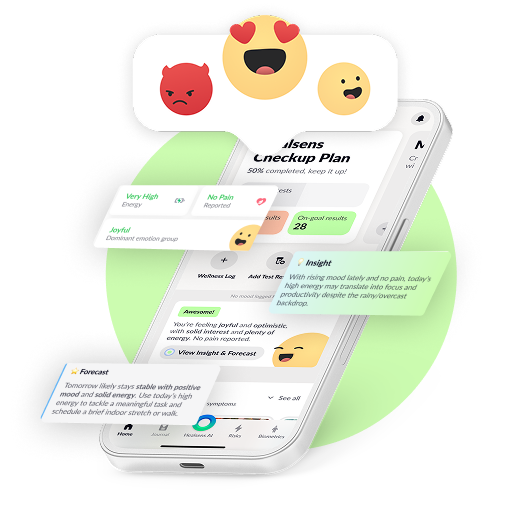
More Than Mood Tracking: From “I Feel Bad” to Understanding What You Need
Healsens is built around two ideas: understanding emotions more precisely matters, and so does responding to them appropriately.
Research on emotional granularity suggests that being able to distinguish between emotional states — rather than experiencing them simply as “good” or “bad” — is associated with more flexible emotion regulation.
To support emotional granularity, Healsens uses a modern Emotion Wheel built around an appraisal-based approach to emotions. Rather than trying to infer an emotion from bodily sensations alone, the app helps users consider their experience, what may matter or be needed in the situation, and two fundamental dimensions of emotional state:
Valence — does the experience feel pleasant or unpleasant?
Energy / activation — do you feel energized and ready for action, or depleted and low in energy?
This distinction matters. Two experiences can have similarly negative valence while representing very different emotional states. Learn more about why valence and energy matter in emotion tracking.
Healsens also allows you to record more than one emotion and its intensity — including emotions that are present only mildly. This helps capture complex emotional states that might otherwise be reduced to a single dominant feeling.
When finding the right words is difficult, the AI Emotional Guide can help. It asks neutral questions to help you explore what you may be experiencing. It does not decide what you feel or diagnose your emotional state. You remain the person who decides which description best fits your experience.
Understand your emotions with Healsens
Identify what you feel, explore what may be behind it, and discover your emotional patterns over time.
From Emotional Awareness to Gentle Support
Understand your emotions with Healsens
Identify what you feel, explore what may be behind it, and discover your emotional patterns over time.
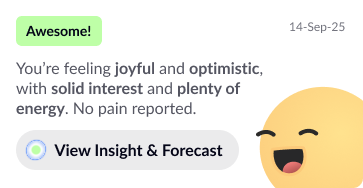
From Emotional Awareness to Recognizing an emotion is only the first step. The next question is: what might help right now?
Healsens starts by helping you understand the emotions you selected. Each emotion comes with a description designed to make subtle differences between emotional states easier to recognize over time. The aim is not simply to build a mood history, but to gradually develop a more precise emotional vocabulary.
The next step is reflection and flexible emotion regulation.
There is no single “right” way to respond to an unpleasant emotion. Research on emotion regulation increasingly emphasizes flexibility: different strategies may be useful depending on the emotion, its intensity, level of activation and the situation itself.
This is why Healsens considers the emotional state you record — including valence, energy / activation and intensity — when suggesting ways to respond. Rather than trying to make an unpleasant emotion disappear, Healsens offers a range of gentle, practical approaches that may fit the state more closely. These can include reflection, creating space for an emotion, movement, etc.
You can also add context in your own words. What happened? What were you thinking about? Was another person involved? This additional context can help make subsequent reflection more relevant to what you were actually experiencing.
Over time, these entries create more than a mood chart. They can help you notice recurring emotional states, situations and responses — patterns that may be difficult to see from a single entry.
If you work with a psychologist or therapist, you may also choose to bring this history into your conversations. A longitudinal record of emotions, intensity and context can provide concrete examples to explore together.
Healsens is not psychotherapy and does not diagnose mental-health conditions. Its role is to help you notice more, describe more precisely, reflect on context and explore different ways of responding.
Questionnaires: a long-term view on mental health
Healsens includes well-known wellness check-in prompts inspired by established psychology tools so you can reflect on how you’re feeling with more structure.
Beck Depression Inventory (BDI) — helps track signs of depression.
GAD-7 — detects changes in anxiety and panic symptoms.
These questionnaires are well-known in research and clinical settings. Within Healsens, they are offered solely to help users reflect on their experiences in a more structured way.
They are not intended to diagnose, treat, or monitor any medical or psychological condition.
If you have concerns about your mental health, we strongly encourage you to consult a qualified healthcare professional.
💡 Smart health monitoring with advanced stress relief technology

Stress Biomarkers: objective measurement of your load
Healsens helps you log contextual factors that researchers often mention—like how your body feels or reacts—alongside your own observations so you can spot patterns over time.
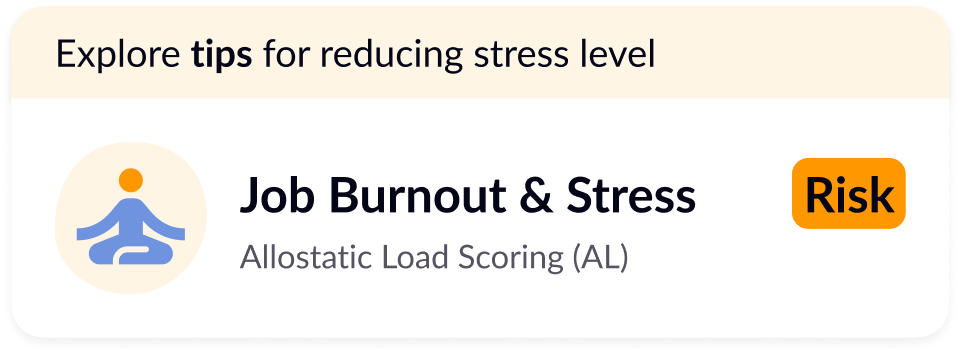
Some users also choose to explore composite research concepts like allostatic load — a framework used in scientific literature to describe how the body responds to ongoing demands.
Cortisol / DHEA-S — hormones commonly discussed in relation to the body’s stress response.
Allostatic load — a research-based framework that brings together multiple physiological parameters in scientific studies.
Together with structured self-reflection, this information can help you better understand patterns over time — both in how you feel and in the data you choose to track.
📊 Measure both mood and biology — your complete path to stress relief
Practices and Techniques: tools for developing stress resilience
Picture stress resilience as water. For one person, resilience may feel like a shallow pool: even a small disturbance can unsettle the whole surface. For another, it may be more like an ocean: the same disturbance creates ripples, but the larger system remains relatively stable. The goal is not to eliminate the wind. It is to build greater capacity to meet it.
Healsens goes beyond measurement. Built-in recommendations include:
Meditations and breathing techniques (such as 4-7-8 and Kirtan Kriya).
Relaxation methods that support calm and help recharge your energy.
Nutrition and supplement guidance that supports balance in the nervous and endocrine systems.
This holistic approach turns Healsens into your personal trainer for stress resilience and effective stress relief.
🧘 Evidence-based meditation rooted in tradition — proven to support stress relief

Conclusion: balance in numbers and actions
Healsens brings together subjective reflections, lifestyle indicators, and laboratory data in one structured overview.
This helps you move beyond simply logging stress — toward building greater awareness of how your habits, experiences, and data interact over time.
Developing resilience is a gradual process. By making patterns visible, Healsens supports you in making intentional choices and observing how they align with your wellbeing goals.